Fátima
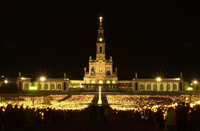
The travelers coming to Fatima usually take out time from their busy schedule to include a tour of the tourist attractions in Fatima. Most of the tourist attractions in Fatima reflect the rich cultural heritage of the country and help the visitors to gather some knowledge. You will have a great time while going in for sightseeing in Fatima as it has something to offer to everyone visiting the place. You will get to see esplanade, the Miracle of Fatima, Museum of Sacred Art and Ethnology, Ourem, Wax Museum, Marina Grande, Milagres, Monte Real, Pombal and Rio Caranqueieira. These are some of the most frequently visited Fatima tourist attractions. |
 |
 |
Batalha
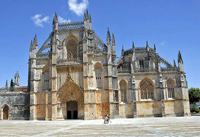
It's worth stopping in this small town to see the monastery of Santa Maria da Vitoria, a UNESCO World Heritage Site. Begun in the late 14th century in gratitude for Portugal's defeat of Castile at Aljubarrota in 1385, the monastery was a main architectural project of the Portuguese monarchy for 200 years. It is also one of the best examples of Gothic architecture in the country. Highlights are the cloister, in particular the beautiful tracery on its arches, and the high-vaulted nave and chapterhouse. The chapel contains the tombs of Joao I, the founder of the monastery, and his famous son, Henry the Navigator. |
Nazaré
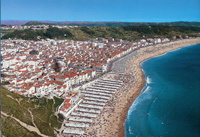
The particularly picturesque little fishing town of Nazaré (Altitude: 0-110m/0-360f) has drawn increasing numbers of visitors in recent years because of its good beaches and the still genuinely colorful life and activity of its fisherfolk. It is now one of the most popular seaside towns on this part of Portugal's Atlantic coast, or the Costa de Prata as it is known. Nazaré is believed to have been founded by the Phoenicians. It is on what used to be a bay, but which is now silted up, sheltered on the north by Monte Sítio. The harbor has been reconstructed relatively recently, doing away with the need to push the brightly painted local boats, with their high pointed prows, into the water from the beach by hand, and then, on their return, using oxen to haul them up on shore again to be unloaded by the waiting women and the fishermen. Another fishing method was arte xávega, whereby nets were laid offshore then hauled in from the beach. Since this no longer pays its way, tourists have to content themselves with the traditional fish auctions that take place daily on the return of the fishermen. |
 |
 |
Óbidos
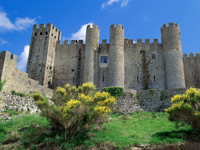
Óbidos (altitude: 70m/230ft)is probably included in every tour of western central Portugal. Because of its prettiness and general attractiveness the whole town has been declared a national monument. This also means that in order to preserve the original townscape there are no big hotels in Óbidos, although there are several small, deluxe establishments inside the old walls. The number of beds is therefore extremely limited, and it is almost impossible to get a room here in the summer months without early reservation. In earlier centuries the Lagoa de Óbidos, a big lagoon with a narrow opening into the sea and now more than 10km/6mi northwest of Óbidos, reached almost to the little town. This Atlantic dimension made Óbidos strategically important and it was therefore strongly fortified in Moorish times. Already a place of great attraction in the Middle Ages, Óbidos was frequently chosen as the queen's dowry, and it was a favorite residence of St Isabel and other queens and kings of Portugal. Queen Leonor lived here for several years, mourning her only son who had been killed in a riding accident. |
Tour Visiting Program
|
- Óbidos
- Nazaré
- Batalha
- Santuario de Fátima
|
|
|